Plain-Language Questions
Users can search using the language they naturally use instead of guessing a manual title, folder name, or exact technical phrase.
Turning the knowledge behind every machine into interactive intelligence your whole mill can use.
Grain-processing facilities depend on equipment documentation, records, and the experience of the people who know the machines best.
V5 Pulse organizes that information inside the facility. Operators, maintenance teams, plant managers, and operations can search, ask questions, review records, and move directly to the source material behind the answer.
This is not generic artificial intelligence. It is Mill Intelligence grounded in the information and operational knowledge of the facility.
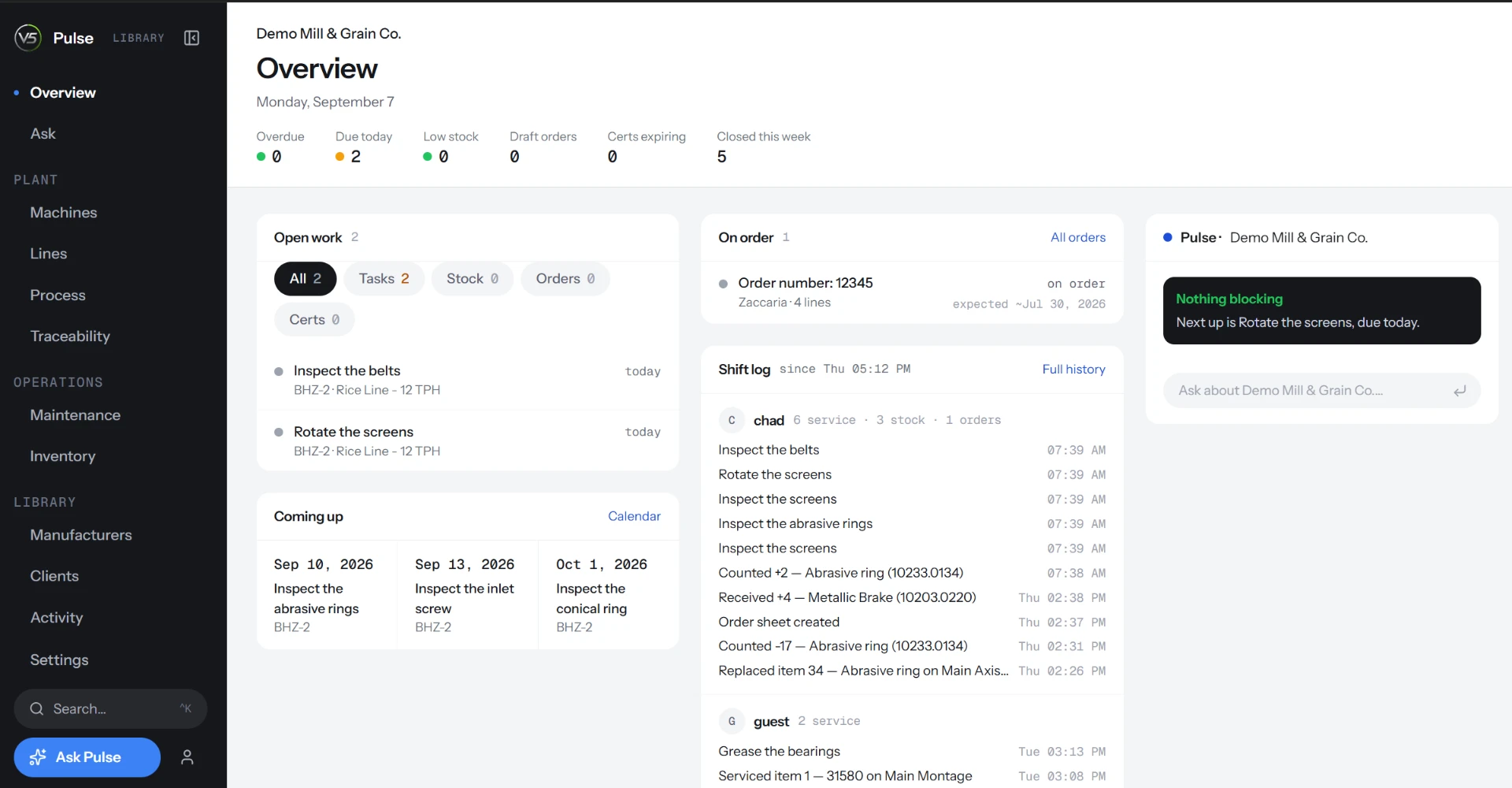
Critical equipment knowledge is often scattered across filing cabinets, spreadsheets, maintenance notes, and email attachments. The information may exist, but the person who needs it still has to know where to look, what document to open, and which page contains the answer.
That search becomes more difficult when equipment comes from several manufacturers, manuals use different terminology, experienced employees leave, or maintenance teams are responding to an urgent production problem.
V5 Pulse creates a machine-centered structure for that information. Manuals, specifications, schematics, parts records, maintenance history, inventory information, procedures, work orders, and operational knowledge are connected to the equipment they describe.

AI Knowledge Assistant
The V5 Pulse AI Knowledge Assistant allows users to ask practical questions in plain language and receive answers based on the manuals, equipment records, procedures, and facility information available inside their V5 Pulse environment.
An operator may need to locate an operating procedure. A maintenance technician may need a lubrication specification or documented troubleshooting step. A parts employee may need a part number or schematic reference. A plant manager may need to understand the maintenance history connected to a particular machine.
V5 Pulse helps the user locate the relevant information and connects the response to its supporting source. Depending on the available documentation, that source may be a manual, schematic, part record, procedure, maintenance entry, work order, or specification.
The purpose is not to replace human judgment. The purpose is to reduce the time required to find the information that supports good judgment.
Users can search using the language they naturally use instead of guessing a manual title, folder name, or exact technical phrase.
Information is organized around the specific equipment inside the facility, not a generic description of similar machinery.
Users can move from the AI response to the manual, page, schematic, record, or source material supporting the information.
Available information depends on the records and documentation provided for each facility.
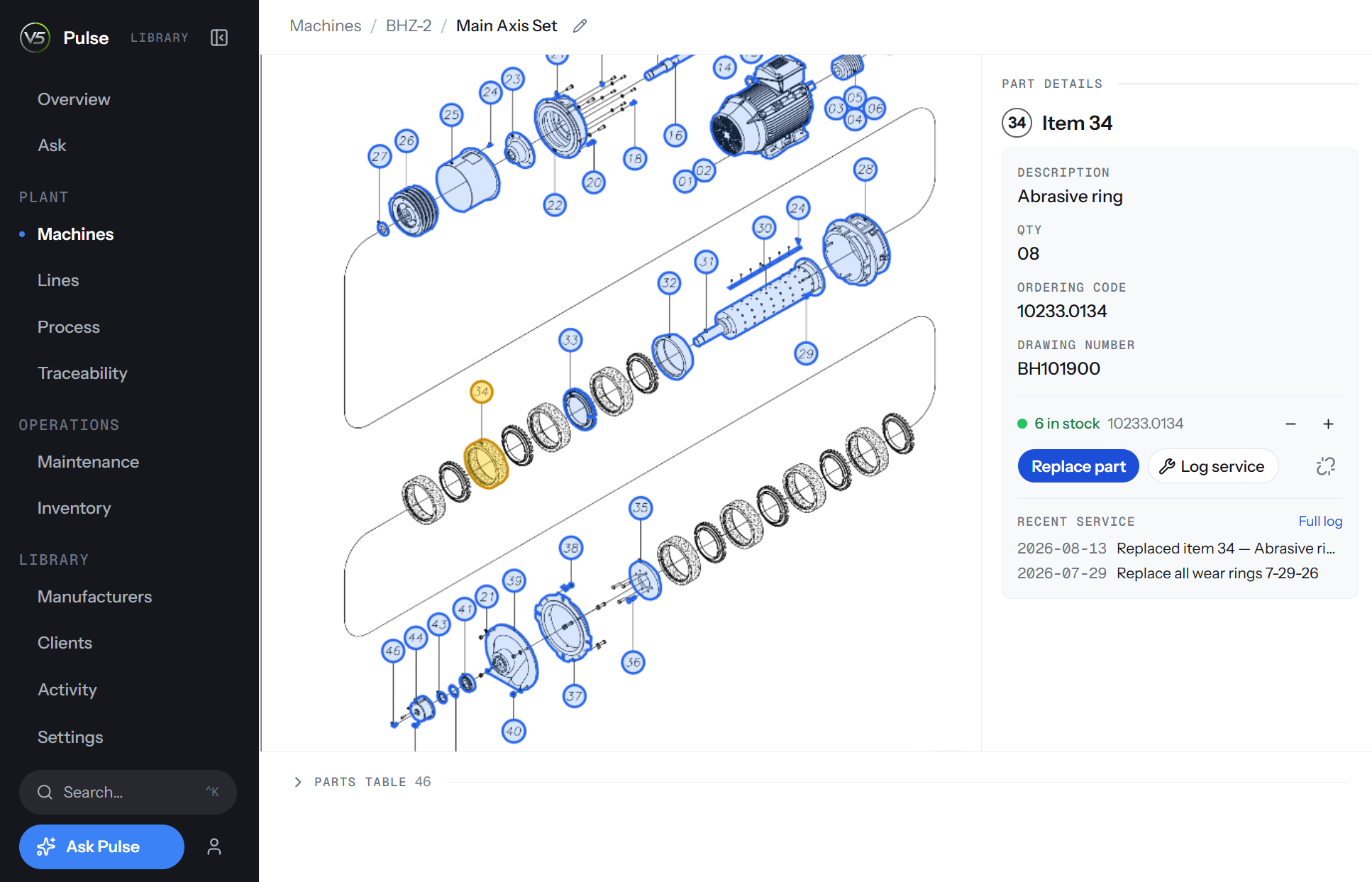
Every machine in the facility can carry its own profile: make, model, serial number, location, installation information, and the documentation connected to it. Users begin with the equipment instead of a folder structure or file name.
Operating manuals, installation manuals, maintenance manuals, and supplements are uploaded, organized, and connected to the machines they describe. Scanned documents, printed manuals, and digital files can be brought into the same structure.
Technical specifications, drawings, electrical schematics, and layout references are attached to the equipment record so the person searching does not have to remember which file or cabinet holds the drawing.
Part numbers, descriptions, references, and supporting documentation are tied to the machine. Parts personnel and maintenance teams can look up a component without rebuilding the research every time.
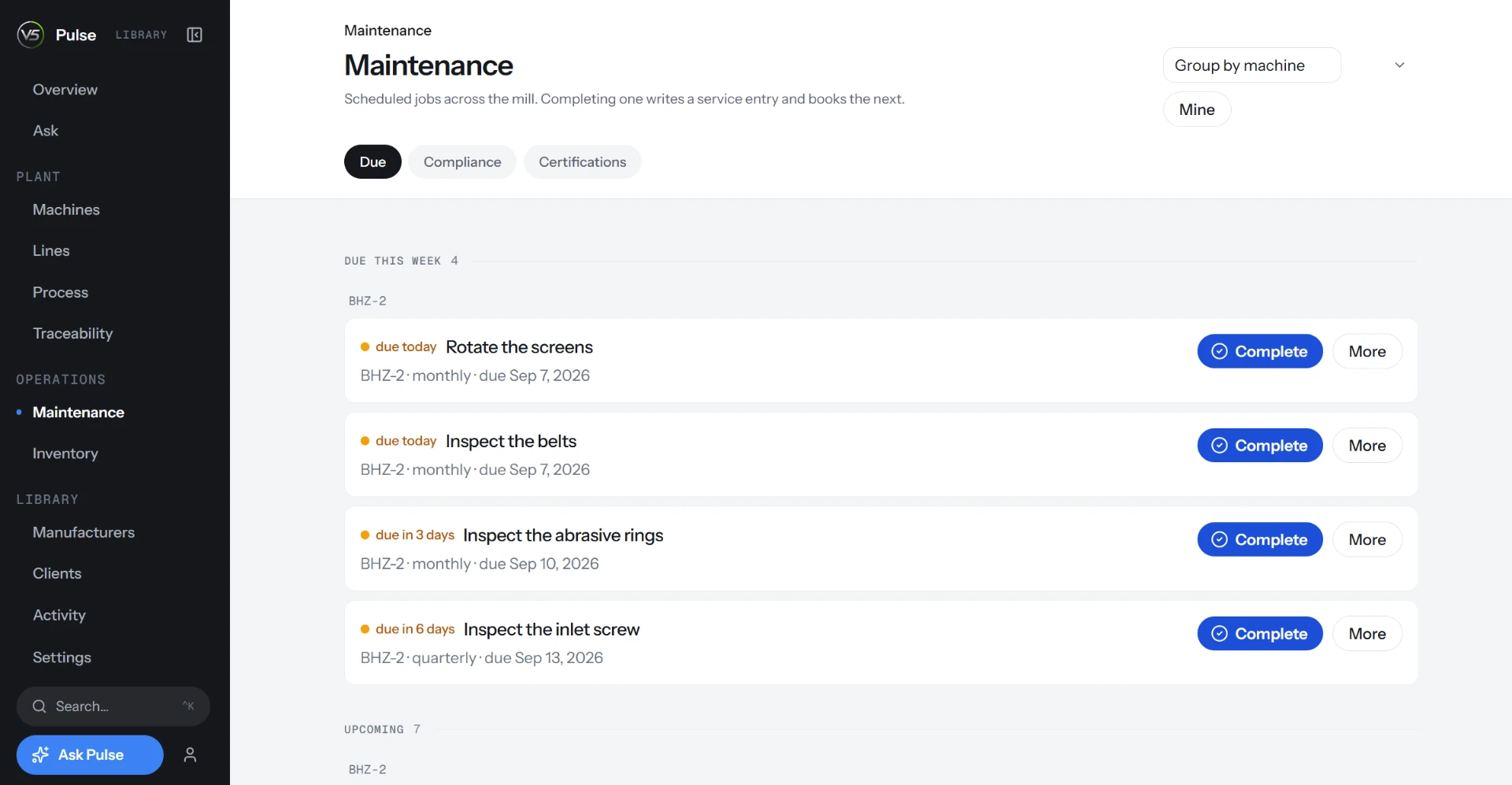
Completed maintenance entries, notes, and service records can be captured and reviewed by machine, so the history behind a piece of equipment stays with that piece of equipment.
Inventory information such as quantities on hand, storage location, and minimum levels can be recorded and reviewed alongside the equipment and parts they support. Inventory is maintained through user entry.
Standard operating procedures, safety procedures, checklists, and work order documentation can be organized in the same machine-centered environment used for manuals and records.
Mill Intelligence is only useful if the people closest to the equipment can use it. Access inside V5 Pulse is set up for the roles your operation approves.
Locate operating procedures, startup and shutdown steps, setting references, and machine information without leaving the floor to hunt for a binder.
Find lubrication specifications, documented troubleshooting steps, drawings, and prior service history for the specific machine in front of them.
Confirm part numbers, review parts documentation, and check recorded inventory information before placing an order or pulling from the shelf.
Review maintenance history, procedures, and documentation coverage across the equipment in the facility to understand where knowledge is strong and where it is thin.
Deliver organized, searchable equipment information to customers so the knowledge behind a machine remains usable long after commissioning.
Work from the same documentation and records the facility uses, instead of assembling information from email attachments and memory.
Every facility starts from a different level of documentation. The work begins with what you already have and builds from there.
We work with your team to identify the machines, lines, and areas that matter most, and confirm who inside the operation needs access.
Manuals, specifications, schematics, parts documentation, maintenance records, procedures, and inventory information are collected from the sources where they currently live.
The collected information is organized around the specific equipment in the facility and loaded into your V5 Pulse environment.
Users are set up and shown how to search, ask questions, review records, and move from an answer to its supporting source.
New equipment, updated documentation, added procedures, and captured operator knowledge continue to be brought into the environment as the operation changes.
The technician on shift can search the machine directly, locate the documented troubleshooting section, and open the supporting manual page instead of waiting for morning.
Parts personnel can review the part reference and supporting documentation connected to the machine before ordering, rather than reverse engineering a part number from a photograph.
New personnel can learn the equipment by machine, with procedures and manuals attached to the specific asset they are being trained on.
Knowledge that lived in notes, memory, and habit can be captured as procedures and records that remain available to the operation.
Documentation written in different formats and different terminology is organized under one consistent machine-centered structure.
Manufacturers and dealers can hand over organized equipment information that stays usable inside the customer's operation.
V5 Pulse works from the authorized equipment information, facility records, and operational knowledge provided for the operation. It is built to help people find and understand that information, not to act on its own.
Final operating, maintenance, engineering, and safety decisions remain with qualified operators, maintenance technicians, engineers, manufacturers, and the procedures your operation has established.
No. V5 Pulse is a machine-centered Mill Intelligence platform for organizing equipment information, records, and operational knowledge and making them searchable. It is not a CMMS, ERP, SCADA, or control system.
Not as a standard capability. Pulse works from the documentation, records, and knowledge provided for the facility; it does not read live sensors or control equipment. Any integration is evaluated, scoped, and approved separately.
Yes. Pulse is organized around the machines in your facility, not around a manufacturer, so documentation written in different formats and terminology sits under one consistent structure.
Traceability Intelligence is a separately scoped capability for operations that have the required data. When it is in scope, Pulse can organize and connect records involving lots, bins, equipment routes, processing activity, packaging, and shipments. It does not guarantee regulatory compliance or create missing traceability data.
Manuals, specifications, schematics, parts documentation, maintenance records, procedures, work orders, and inventory records that your operation is authorized to share. Scanned and printed material is fine.
That is normal. Bring us your worst manual. Part of the work is taking imperfect source material and organizing it around the machines it belongs to so it can be found and used.
Only the users your operation approves. That may include operators, maintenance personnel, parts employees, management, and approved manufacturers or service partners.
It depends on the size of the operation, the equipment included, the documentation involved, and the number of users. We review those details with you directly rather than publishing pricing.
Show us the equipment, the documentation you have, and the questions your team keeps having to chase down. We will walk you through what a machine-centered V5 Pulse environment would look like for your facility.
Evaluate and source equipment from the right manufacturers.
Explore Grain Processing EquipmentConnect responsibilities, information, schedules, logistics, installation, and startup.
Discuss Your ProjectPreserve the equipment information and operating knowledge behind the facility.
Explore V5 Pulse Mill Intelligence